Gray whale migration brings one of the Pacific’s great wildlife journeys past Southern California each winter and spring. Whales traveling between northern feeding grounds and Mexico’s breeding areas pass the Los Angeles coastline twice, giving visitors a chance to see both southbound adults and the later return north.
Quick answer: Plan a Long Beach gray whale trip between December and April. December and January are useful planning months for southbound whales; February and March bring northbound traffic, with mothers and calves generally later in spring. Timing overlaps and changes from year to year. No particular week guarantees a sighting.
If your dates are flexible, decide what interests you most: the steady winter migration or the possibility of a mother traveling with her calf. Then check recent local reports and choose a departure that fits your day. A seasonal calendar narrows the possibilities; conditions on the water determine the actual trip.
The gray whale migration route from Alaska to Baja
The eastern North Pacific gray whale migration connects feeding habitat in northern seas with winter breeding and calving areas around Baja California, Mexico. Many whales spend the productive summer months feeding in the Bering and Chukchi seas before heading south along the Pacific coast.
A typical round-trip description is roughly 10,000–12,000 miles, although distance depends on the individual and its endpoints. Some gray whales travel farther, and not every whale follows the same itinerary. A whale feeding off the Pacific Northwest has a different journey from one traveling well into the Arctic.
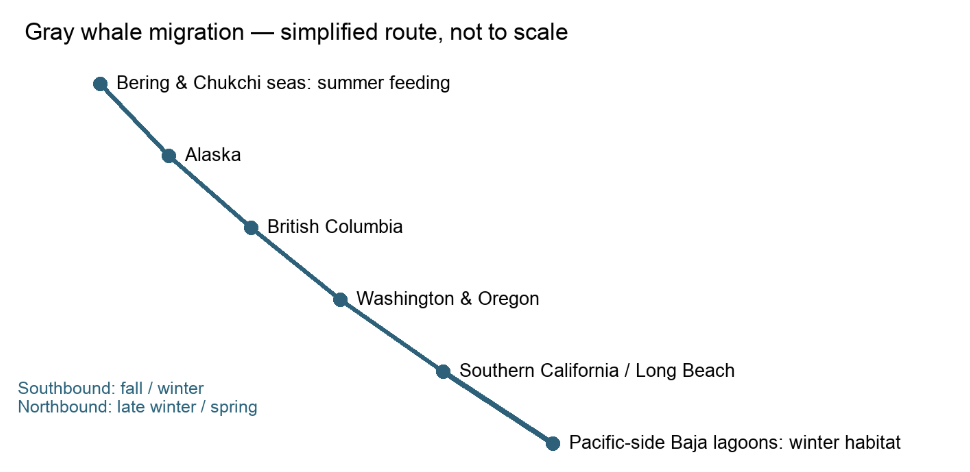
The route passes Alaska, British Columbia, Washington, Oregon and California before reaching Baja. Important winter areas include Laguna Ojo de Liebre, Laguna San Ignacio and Bahía Magdalena on Baja’s Pacific side. Those place names matter when planning travel: the best-known gray whale lagoons are not in the Sea of Cortez.
People searching for “Sea of Cortez whale migration” may be looking for a broader Baja wildlife trip. The Gulf of California supports other remarkable whale encounters, but it is a different destination from the Pacific lagoons associated with gray whale calving. Check the actual location of a tour before booking flights or ground transportation.
Route schematic: northern feeding areas → Pacific coast → Southern California → Pacific-side Baja lagoons. Southbound travel is mainly in fall and winter; northbound travel is mainly in late winter and spring. The line is illustrative, not an exact track for every whale.
Why make such a long trip?
Northern feeding areas provide seasonal food that helps whales build energy reserves. Warmer winter waters provide breeding and calving habitat. The journey connects these parts of the annual cycle, and a female’s reproductive status can influence when she travels.
That is why migration happens in waves. Pregnant females, other adults, juveniles and mothers with calves do not all move together. Looking at the migration as a season-long flow is more useful than imagining a single herd arriving on one date.
Southbound and northbound timing by month
The table below is a planning guide for Southern California, not a forecast. A few early or late whales may appear outside the main window, and different parts of the coast experience different peaks.
Month | Main migration pattern | What it means for a Long Beach trip |
|---|---|---|
November | Early southbound movement may begin to reach the region | Treat gray whales as a possibility rather than the seasonal expectation |
December | Southbound migration becomes more established | A useful winter month for travelers interested in the route to Baja |
January | Strong southbound passage is typical | Watch for purposeful travel and repeated surfacing sequences |
February | Late southbound and early northbound movement can overlap | Direction matters more than assuming every whale is heading the same way |
March | Northbound migration becomes prominent | A good planning month for the return journey |
April | Later northbound whales can include mothers and calves | Calf encounters are possible, with timing varying annually |
May | Late northbound passage may continue | Ask about recent sightings rather than assuming the winter pattern continues |
The southbound journey
Winter travelers often see whales making steady progress toward Mexico. A whale surfaces, takes several breaths, then disappears again as it continues along its route. The crew watches its direction and movement rather than treating each blow as an isolated event.
December and January are practical months to consider if seeing migration is the main reason for your visit. They are not a promise of the year’s highest count on your chosen day. Storms, visibility and the distribution of whales can change what a boat finds even within a productive period.
The northbound journey and calves
The return north begins before every southbound whale has passed. Adults without calves generally lead the northbound flow, while mothers with young calves tend to travel later. This creates a longer spring viewing window rather than an abrupt switch in direction.
A mother-and-calf sighting is especially meaningful when you understand the trip ahead. The calf must keep pace, nurse and grow while moving toward feeding habitat. Give these animals room: a viewing trip should never interrupt the pair’s travel or separate them.
Why Southern California is a front-row seat
The California coast lies along the migration corridor, so you do not need to travel to Alaska or Mexico to witness part of the journey. Long Beach provides access to open coastal waters where boats can look for migrating whales while also watching for dolphins and other marine life.
The Catalina Channel and surrounding waters are a broad search area, not a fixed lane with whales on a timetable. Some gray whales travel close enough to shore to be seen from coastal viewpoints; others take routes farther offshore. Weather, bathymetry and individual behavior all shape the day’s possibilities.
Avoid planning around a guaranteed distance from the beach. Even a nearby whale can be hard to spot when glare or whitecaps hide its blow. Conversely, a distant spout may be visible from a high viewpoint in clear conditions. Height, light and patience matter alongside distance.
For boat passengers, the advantage is a mobile viewpoint and a crew interpreting what is happening. A captain can choose a route based on conditions and reports, while an educator helps distinguish a traveling gray whale from another species surfacing nearby.
Where to watch gray whales near Long Beach
By boat from Rainbow Harbor
A Long Beach whale watching tour gives you a chance to observe animals in open water with a narrated explanation of their behavior. Harbor Breeze departs from Dock 2 near the Aquarium of the Pacific. Check the departure address and arrival instructions on your reservation before setting out.
Bring layers even when the waterfront feels warm. Wind over moving water can make a winter trip feel much cooler than a walk ashore. Flat shoes with traction, a secure hat and binoculars help you stay comfortable and ready when a blow appears.
A tour is a search for wild animals. The route may change, the boat may slow for a sighting, and some animals will remain underwater longer than you expect. That flexibility is part of the experience, not a sign that the whales have missed an appointment.
From Point Vicente and the Palos Verdes coast
Point Vicente is a well-known land-based place to scan the migration corridor. Elevated coastal viewpoints around Palos Verdes can also offer broad ocean views. Use designated public areas, check current access and stay back from cliff edges.
Start by scanning with your eyes, then raise binoculars after finding a blow or movement. Searching through a narrow magnified view the entire time can make it harder to find an animal. Watch the same patch of ocean for several minutes: a whale you briefly lose may surface farther along its direction of travel.
Land watching suits visitors who want a flexible stop or prefer to remain ashore. A boat offers a different perspective and a wider moving search area. Both reward realistic expectations and enough time to watch beyond the first few minutes.
Behaviors to watch for
Spouts: The visible blow is a cloud of warm breath, moisture and spray. Gray whales have paired blowholes, and their blows can look heart-shaped or V-shaped from the right angle. Wind can distort that shape, so it is one clue rather than a complete identification.
Flukes: A whale may lift its tail before a deeper dive. Keep the camera ready after a sequence of breaths, but remember that not every dive ends with a raised tail. Watch with your eyes as well as through the screen.
Spyhopping: A whale raises its head above the surface, offering a very different view from its usual low profile. It is often described as looking around, although an observer cannot know the purpose of every movement.
Breaching: A leap and splash can be unforgettable. Breaches are possible, not scheduled entertainment, and many rewarding sightings involve quiet travel instead. Never judge a trip solely by whether an animal jumps.
Resting at the surface: A whale may appear almost motionless between breaths. The crew can help explain whether the visible pattern suggests rest or slow movement. A calm animal deserves the same respectful space as an active one.
Population and conservation
NOAA’s estimate for the eastern North Pacific population in the 2025/2026 survey period is approximately 15,930–20,530 whales. This follows a lower estimated range of about 11,700–14,200 in 2024/2025. These are survey estimates for a particular population, not a count of every gray whale worldwide.
The apparent increase does not establish a rapid biological recovery. NOAA notes that recent changes can exceed plausible population growth, particularly when calf production is low. Migration changes and survey or analytical factors may affect how many animals pass the counting area. See NOAA’s current abundance assessment for the full explanation.
The 2019–2023 unusual mortality event has closed, but that does not mean monitoring or concern has ended. Gray whales still face entanglement, vessel strikes and changes in their feeding environment.
Passengers can help by choosing respectful wildlife viewing, keeping litter out of the ocean and following crew directions. If you see a distressed animal, alert the crew instead of attempting to approach it. Watching the migration can build appreciation without adding pressure to the animals making it.
Gray whale vs. blue whale season planner
Winter and spring are the main planning window for gray whale migration. Summer and fall are associated with blue whale feeding opportunities off Southern California. Harbor Breeze describes its broad blue whale window as May through November, with actual encounters depending on where food is concentrated.
Choose winter if the journey between Alaska and Baja is what draws you. Choose the warmer part of the year if seeing the immense scale of a blue whale is your main interest. Humpbacks, fin whales and dolphins can add variety, but none should be treated as a guaranteed extra.
For a more detailed local calendar, use our guide to whales by month in Southern California. For the animal behind the migration, explore our gray whale facts.
Gray whale migration FAQ
What is the best month to see gray whales in Long Beach?
January is a useful choice for southbound migration; March is useful for northbound passage. December through April is the broader planning window. Choose spring if a mother-and-calf encounter is a particular interest, while recognizing that sightings vary.
Do gray whales migrate twice a year?
They make a southbound and a northbound leg within an annual migration cycle. Individuals differ, and some feed in more southerly areas instead of traveling to the farthest northern grounds.
Is grey whale migration different from gray whale migration?
No. “Grey” and “gray” are spelling variants for the same whale. Both searches refer to the migration described here.
Can I see gray whales from the beach?
Sometimes, especially from elevated coastal viewpoints in clear conditions. Binoculars help, but a short stop cannot guarantee a sighting. A whale watching boat provides another way to search the coastal waters.
Are the Baja gray whale lagoons in the Sea of Cortez?
The best-known lagoons in this migration story are on Baja California’s Pacific side. The Sea of Cortez is east of the peninsula and offers a different whale watching setting.
Do I need to book before gray whale season starts?
Advance booking helps you secure a preferred departure, especially when travel dates are fixed. Check Long Beach whale watching availability and leave time before boarding for parking and check-in.